Welcome back to Hunter by Nature, a blog dedicated to sharing stories of the outdoors, research, and conservation. Today’s blog entry is being written at the Incheon Airport in Seoul, South Korea.
On June 2nd, I left for the George Bush International Airport, which was shockingly efficient (15 minutes to check and my bag AND get through security). I’ll admit it, I am was not made for backpacking, as I am a chronic overpacker. However, two duffles and a backpack, isn’t really that bad for two and a half months… right? My field assistant Diana met me at our gate. I’m so grateful to have her on the team. With that, began our 40 hour journey to Indonesia. Between flights and layovers, I imagine I’ll be rather sleep deprived tomorrow.


Preparation for this trip really began in August 2024, when I discussed my research ideas with my advisor Dr. Gursky. Those early talks about hypothesis and methodologies eventually led to the need to choose a study species. Dr. Gursky pointed me in the direction of several species, including the pygmy tarsier (Tarsius pumilus).
If we were to look at tarsiers (tarsiidae) from a human point-of-view. They are second most distant cousins. (Please note that the below image doesn’t go in-depth)

CK-12 College Human Biology by Brainard, J. and Henderson, R.
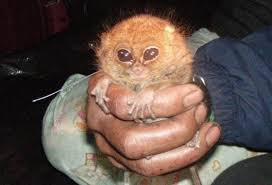
Pygmy tarsiers were first found as specimen in 1921. However, they were not found alive in the wild until 2010 when Dr. Sharon Gursky, Dr. Nanda Grow, and their team of researchers located them on Mt. Rore Katimbu in Sulawesi, Indonesia.1 The genus tarsiers (Tarsius) are already a pretty small-bodied, but pygmy tarsiers are even smaller (only 50g!!). These little guys will be the focus of my work in the upcoming months!


Thanks for tuning in to this brief travel and prep update, look out for more posts soon!
- Grow, N., & Gursky, S. (2010). Preliminary data on the behavior, ecology, and morphology of pygmy tarsiers (Tarisus pumilus). International Journal of Primatology, 31, 1174-1191. https://doi.org/10.1007/s10764-010-9456-9 ↩︎
 Hunter by Nature
Leave a comment